Without a Rider in Control
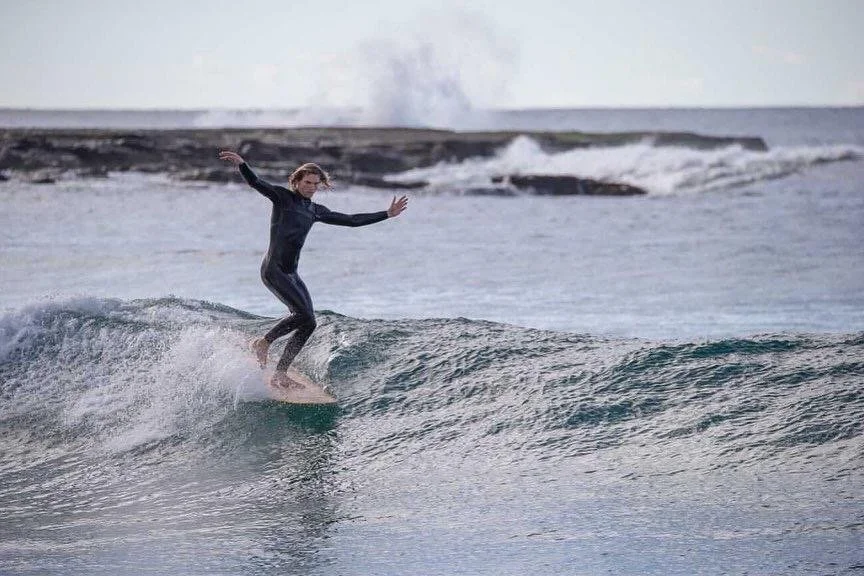
Surfer Featured: Harry Peters (Instagram @harrypeters122)
What if a surfer and the ocean meet—designing a choreography of longing, a dance shaped by the desire for a life that feels free? Each ride becomes a sacred scripture. A surfer carves lines into the water’s fleeting skin, moving with and across the face of opal-eyed molecules.
While the ocean holds neutrality, unbiased, detached, existing without preference, it becomes a beckoning mirror of the surfer’s mind. Because the mind, rich in knowledge, calls for control, outcome, self-grasping and the concept of time. It supersedes surrender and weeps the need to know. The ocean, its waves, all simply are, the surfer must move their mind, or more truthfully, let go of it, to meet them in harmony.
The ocean and the mind can feel like polarities. A knowing too familiar to every wave-seeker. One demands narration; the other, presence. The mind may embody everything life warns us against, while the ocean draws out our shared humanity, inviting us to meet life as it is.
We know how easily the tyranny of thought can displace us, leaving us too shallow, too deep or too late to show up fully, not as we wish to be, but as the wave, in its quiet wisdom, is asking us to be.
Fear, of missing the drop, of being rolled, of touching the edges of our self-made limits, can summon the very wipeout we hoped to avoid. One moment of lost presence, and the chance to meet the wave in perfect harmony slips away.
Here arises every surfer’s intuition; their mind depicts their ability to meet the ocean as a canvas for freedom or restriction. Its shimmering surface might just bring to the crest the most profound question humanity can be given: Does the world shape our perception, or do our perceptions shape the world?
Maybe this question drives many a surfer’s motion, the infatuation with the unknown, alarms ringing in the dark, foreign islands, new boards and the unrelenting pull of the ocean’s shore. All of it, a free fall into the slow drop, the carving bottom turn, the hollow exit poised to bloom. The ocean answers it day after day. It reflects the truth: that everything which unfolds is shaped by our relationship with it and how we choose to see it.
This is why surfing becomes an expression of the surfer, their mind writes the lines they follow. Life becomes an expression of the way they see it. A surfer riding a wave is a living metaphor for the question: Are they carving the wave, or is the wave carving them?
It all comes back to what surfing demands of the surfer. What does it truly take to surf with a wave, rather than against it? To connect, to be present without our land-locked selves. What the surfer sees in the wave is simply themselves, their mind’s navigation and understanding of their relationship with the world around them, their fears, freedoms and dreams. As the ocean asks us to listen, to understand life beyond the concrete, where the whispers of the mind dwell, surfers are drawn back to this quiet truth. Hold-down after hold-down. Cutback after floater. Straight into a closeout that humbles our control over life.
At the root of it all lies a deeper human yearning: to own the way we see life, rather than feel as though life owns us. Perhaps that’s why the firing frontside rides of morning return this clarity, when life on solid ground feels like too much to carry.
What else brings us to such clarity? Hindsight may be the answer, our greatest teacher. Showing us how life exists by seeing it in reverse. We can observe the evolution of surf culture and see how it parallels the world’s changes, reflecting one another. It’s as if surf culture mirrors the movements of society, the same minds shaping our world are also influencing surf culture. The only true common denominator may be the mind—not the world it perceives.
The boards we ride. The gear we wear. The way we treat the ocean. The respect we hold in the line-up. Decades ago, it was all about ritual, art, connection, and culture. Simple, authentic ways to meet the ocean. The ocean only resembled a sacred place, and surfing was a tool to connect with it and with nature.
Now, we’re centred around performance, pushing surfing to its limits and focusing on how we look while doing it. Always progressing. Appearance over connection. Dozens of boards. A fading respect for surf etiquette. Surfing has begun to echo the patterns of commodification. These days, our surfing connections and equipment are often valued more for what they offer us transactionally than for their intrinsic worth. We appear to use what is around us, rather than respect it.
We can see how the character of surfing has changed—from Gerry Lopez’s slow, enlightened subtleties to today’s forceful, explosive cutbacks. And perhaps this reflects our collective shift from presence to performance, from stillness to speed. As we've become another cog in a breakneck-paced system, maybe the surfer's line reveals something deeper: whether we are pushing, controlling or surrendering.
We may then ask: what truly separates water from land? And what if life itself holds a mirror to the mind—reflecting not just who we are, but how we relate to all things? If so, then perhaps within that reflection lies a powerful lens, one through which we glimpse the potential for transformation. For it is we who determine the quality of our relationships: with the self, with the world, with each wave that rises and falls.
What if real transformation, real change, starts in the minds of each person co-creating this world? What if surfing is the teacher that explains that to us? That it’s not about fixing or changing the structures themselves, but about shifting the perceptions of the people who build them.
It’s like trying to change the shape of a wave to fit how the surfer wants to ride it. We just can’t, it goes against the very nature of things. The wave is what it is. We adapt to it, not the other way around.
And yet, here we are. Our landlocked minds still trying to bend the world to our will. We keep asking nature, systems, and each other to change from the outside in. But the shift must start from within. That’s the only way anything ever really changes.
Perhaps the ocean’s greatest salt-ingrained teaching is this: the truth about control. About perception. About the kind of freedom that exists only in the right relationship with life. To accompany the land with respect. To reach toward one another and ourselves. To navigate tribulation like a surfer reads lines marching in from the horizon, moving with what the wave requires not what we desire. By realising: the mind is not our centre. Concepts build barriers. Attachment to the self pulls us off balance. Perhaps the ocean simply personifies our reflection—an expression of our relationship with life and ourselves.
Surfing is not an escape. Not just a ritual, sport, hobby or addiction. We’re drawn to the wordless expression of presence—the free fall, the tube, the kickout. Not to escape life, but because this is life. Living as a human, without needing to be in control. Freedom from the self. We’re all just swimming in an ocean of longing, unaware that the ocean itself is our longing.
What if surfing is how humanity finds its way back, one salty heart at a time. A reminder that we’re only ever chasing our own reflections. The transformation our aching Earth needs begins behind our eyes. It begins within us. It could be the very fact that we cannot control the ocean that makes us love it so fiercely. Letting go into something greater, surrendering to uncontrollable freedom, is the most human thing of all. A recalibration. A compass pointing us back to Earth, to each other, where life exists and we do not try to control it, but how we see it.
It may be that our world needs transformation not because it is broken, but because individuals have lost autonomy over how they perceive it, warped by outward longing, dependency and the noise of more. Surfing, consciously or not, may have the ability to restore that autonomy. It reshapes perception, not just of waves, but of life itself.
So it doesn’t matter whether we shake hands with God, lock eyes with Buddha, dance with Shiva or sip tea with the possibility of enlightenment. Each as we rise to meet the pale-skied mornings, carving bottom turns into salt-laced waves after breakfast. Perhaps what matters more is whether we meet ourselves. What kind of humanity are we if we cannot bear to look inward, if we cannot face the weight of our own freedom or the quiet heaviness of the thoughts we carry?
We may dream of revolution, the holy grail of ideology, the collapse of capitalism or the levelling sands of poverty, but true reckoning lies in a different place, in the quiet meeting of ourselves on the ocean’s waves. Real change does not come from re-engineering systems alone. It comes from how each living being affects another, from the truth that every part, no matter how small, is essential to the whole.
When freedom wakes from its long slumber, it might not roar, it might look like one more paddle out, like how we choose to show up, the zip of a wetsuit, the smear of zinc, the sacred, mundane rituals of presence and belonging. Maybe change lives in that final free fall, in one more hand-drawn line, not just for the waves or for ourselves, but for the story we are writing for humanity’s direction.
This is the world we have made, built around the healing rhythms of the ocean. And maybe, just maybe, it is also the world we are all trying, quietly and imperfectly, to heal and remake in the best way we can. Could it be that the ocean knows the way, and that surfing, through its silent wisdom, offers us one of the deepest understandings of how to do this?