Monks and Surfers Meet
The merging place of swell lines, the rider’s mind, and Eastern philosophy.
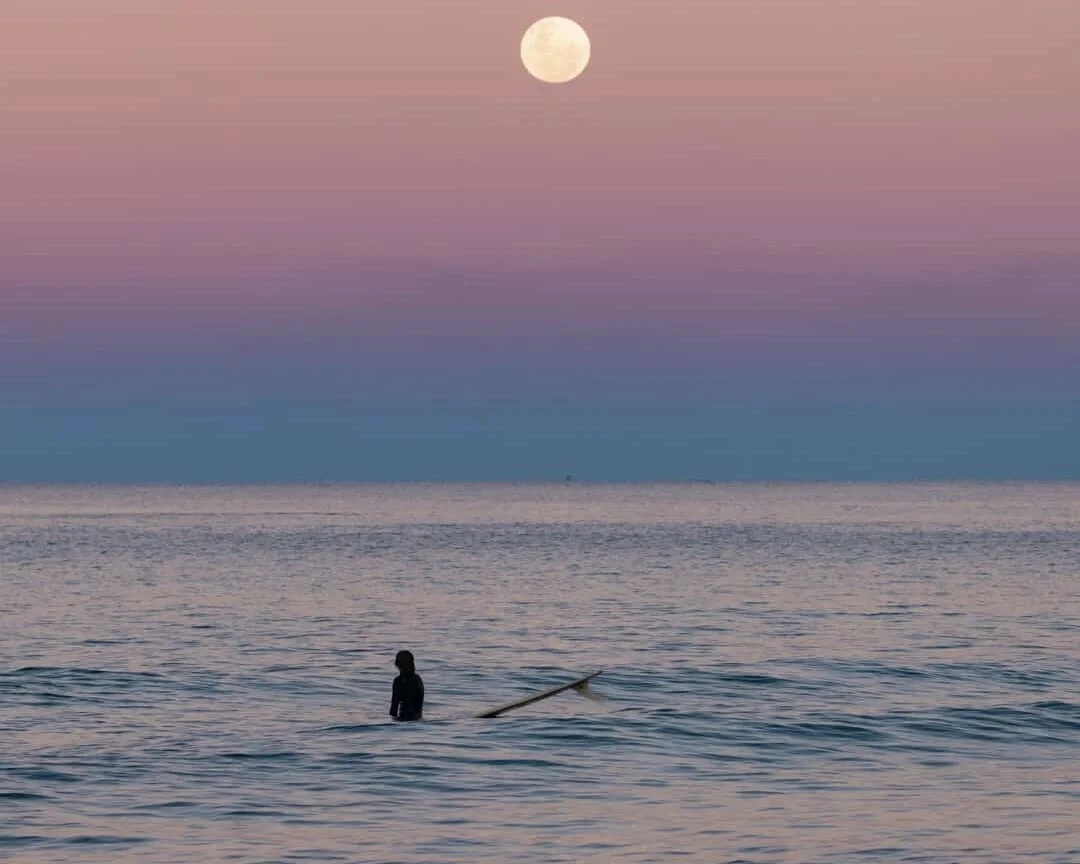
Surfer Featured: Edith Watson (Instagram @disco_dolll)
Are surfers the monks of the ocean, and malas the surfboards of the land?
A monk searches for what can never be attained; a surfer searches for what will always be unreachable: the direct connection with the forever of now.
The freedom of surrender—to surf without a mind.
The freedom of living—without attachment to a self.
A surfer and a monk fight the very worlds they live within, refusing to yield to outdated dialogues of existing. They refute the collective illusion we all sustain: a world that teaches us to turn against our experiences, that asks us to resist them rather than to align, to conceptualise rather than to inhabit. It is a world that feels content to dwell within the narratives of the human mind, rather than in the unmediated honesty of life’s unscripted ecosystem.
Both wrestle, not for mastery but for connection. They protest a return, for what precedes our breakneck pace definition, humanity’s inherited notion of freedom: freedom as attainability, as possession, as productivity. For the same world that whispers comfort also shouts constraint, it insists that only when our outer conditions bend to our inner longings can we call ourselves free.
This liberation arises when one is no longer governed by the material, the past, the future, what lies outside the observer. When the gaze of the seer no longer clings to the ebbing tides of the world or the unruly flow of the ocean.
The monk and the surfer both seek this surrender, this release: a freedom not born from possession or acquirement, but from understanding. The soft recognition that their practice is itself the doorway to what they seek.
Each, in their own way, hears and honours the same time-worn whisper: that what is sought has never been elsewhere, and is unveiled only through direct communion with the moment they live.
This is the beckoning call of the surfboard and mala. The offering to the artisan of water and ground. To the one brave enough to look at life on the far side of the sky, the reach of our forever-present, dreamy, and dark companion: the mind and its dictation of life.
They both work as craftsmen, using their craft, the peeling face of the shoulder summoned by the travelling groundswell and the orange robes evoked by the question of what our inner landscape looks like in worldly isolation, as a vessel through which they learn to navigate the experiences they are asked to live.
The practices of meditation and manoeuvre allow us to ask: where do our internal states awaken, if the life lived outwardly no longer seems to create them?
What decides our attachment or our freedom to experience, to another, to mysto breaks or mantras?
We intuitively know this tension — in the whitewater of thought — that we are always swaying between these poles as we move through our union and division with offshore and onshore, flat and mack, lulls and sets.
The ocean reflects to the rider the transcripts of many Eastern philosophies.
As a monk sits, chanting sutras, he commits to embodying the philosophy’s wisdom: life is always in a state of change, and it is simply our minds that see it as permanent, stable, and able to be controlled.
As he sits, he silently meditates, working with his mind to transcend it. It is our mind’s misunderstanding of life’s impermanency that causes us to attach ourselves to certain experiences and feel aversion to others because we believe they create our suffering or freedom.
We believe that the moment we inhabit will endure forever, preserved with the same identity, form, and feeling. That life will replay our current sight, and as we embody this belief, the present moment feels to reveal itself as a forever concept of our lives.
Rather than understanding, it is our mind’s relationship to experience that determines the polarities or unison we feel, the push or pull, the nosedive or tuck-in. Because life exists in a constant state of change, all that can be known is our perception of it.
Siddhartha Gautama, known as the founder of Buddhism and living between the 6th and 4th centuries BCE, spoke of this truth long ago. Demonstrating the timelessness of insight, he said, “The world is a looking glass. It gives back to every man a true reflection of his own thoughts.” He also taught, “No one outside ourselves can rule us inwardly. When we know this, we become free.”
As a surfer sits, they see this truth, not in transcripts, but in their bond to the oncoming lines. It is recognised in every clean-up set, in every pearling, bail, and snake. Because the rider becomes the offering, the movement beyond the mind, they become the experiences of life itself, because they exist as life itself. They become free through direct connection to the wave.
Why? Because to surf every line a wave dictates, one must work with what is not within their control. One must work with what is always changing, and with what cannot be predicted by human perception, but only understood through direct relationship to it.
No mind of a surfer can ask for the position of God, creator, or composer. If it does, the surfer’s relationship with the wave fractures, and rider and ride fall out of sync.
When the mind does not ask for these positions, the mind still lives within the surfer, but the surfer no longer identifies with the narration of experience. They simply become the experience.
This knowing does not cease to exist, despite surfers living and surfing under different ocean names and breaks. It further solidifies the undertone that it is the surfer’s mind that creates the experiences they yearn to make, and that surfing is the canvas upon which this life painting unfolds. As Rob Machado said, “The ultimate goal of surfing is to be one with the wave and ride it to perfection.” Similarly, Bodhi, from the well-known surf film Point Break (1991), describes it as a state of mind, “that place where you lose yourself and find yourself.”
Here, in the skyline beyond the mind, the waves move through the rider. The rider moves to the beat of nature, not self. Every takeoff, drop-in, nosedive, and unmade wedge or tube entry exists, simply exists, because the surfer allows them to, without resistance.
Every surfer knows that swell gives desire no oxygen to roar. Every external crutch the surfer uses to make the surrounding waves play to their yearnings is stripped bare by the spray’s grasp.
The ocean is in control, even when the mind fights for dominance. The mind assumes the role of conductor, yet does not understand that its true place is within the orchestra.
We are constantly reminded of this, whether paddling out at our local beach or at a distant reef bank we have travelled days to reach. We are here to experience the unique experiences of each set, and it is the sea that chooses the sessions each day holds.
As surfers, we must learn (and continue to relearn) how to live in direct connection with what the reef, sand, and beach breaks have gathered, and to hold it, absolutely.
Herein lies the meeting point, the understanding between board, rider, and ocean. The truth of the sea shows the surfer the truth of the mind: how it sleeps in constant resistance to life; how the mind’s narration is, too, simply another aspect of life existing. It is not clear. It is not right. It is not the creator of our life, although we give it so much power daily.
Sitting out beyond the break, we surfers allow life to drift perpetually through transitory states of expression, and the ocean’s unfolding becomes the gateway through which we learn to inhabit change absolutely. Rather than remaining within conceptualisations that divide life into this and that, wrong and right, desired and undesired, we sit within the harmony of constant change—knowing this to be the singular identity the ocean holds.
The wind shifts from west to north, turning cross-shore. The banks morph into constant unknowns. Oncoming swell lines refuse the definition of replica. Currents move us in time along with them. Inhabiting change offers a freedom born of relinquished control, and surfers enter this state as soon as they understand the lexicon of the ocean’s names. They are given no other option.
Our responses in the ocean become simple truths of that change, a dynamic reciprocity of fluidity. Swell lines shift, and we move. The tide returns home, banks are exposed, and we follow. Faster, quicker, we become the steepness the wave requires. When the swell dries up, we wait patiently. When the faces suddenly show head-high, our logs give way to boards with less length, less volume and more fins.
This intoxication with dissolution allows thought to fall asleep where it began. This quiet conspiracy of honest freedom teaches us how to let the life we are living now breathe for us—the surfer momentarily dies to existing and suddenly becomes a co-exister.
When the sea bed gazes at the surfer through the bank beneath, the world outside ceases to exist. Here, upon this reflection, the world within learns to breathe independently of the world we lean on for our internal composition, and we are shown where life truly resides.
This ocean we adore, brings us into direct relationship with every experience with feverish beauty. We see life in neutrality, in honesty, we see it as it is. The unconditional becomes our internal composition, and our reliance on experience, on others, on life itself to bring about freedom within conditions, falls into the salt’s silence.
Are monks and surfers one and the same, reflections of each other, and of the life we inhabit, living on different faces of the Earth?
Both use their craft as tools to snake disconnection, for both sit upright, one resting on wax, the other on a cushion, in the knowing that the polarisation between our human truth and the world feels frighteningly vast. Because both dwell in the knowing: that the honest feeling of freedom and the way we live are worlds apart.
Their tools, their craft, their practice, these are the methods through which they become free from this divide. Surfing may well be the living application of many Eastern philosophies, or perhaps the ocean’s own philosophy. It is the way each craftsman’s practice closes the chasm between whether we experience suffering or freedom.
It allows the surfer to rest in the limbo between mind and life.
As a surfer moves between land and sea, the rising crests and troughs help the surfer to remain in that limbo, gazing toward the horizon where water meets sky. Surfers wait patiently. In the limbo of the sea’s oncoming heartbeats, the space between what has happened and what has yet to come, the precious moment between waves offers every surfer an invitation: to return to a world of silence, to perform a re-entry into everything unattainable.
Perhaps, the inward-looking land dweller and the outward-seeking ocean lover lie side by side in pursuit of what remains suspended in the limbo of our lives.
In the hollow of a wave, the surfer dissolves into the unattainable.
In the stillness of silence, the monk becomes what was never lost.
Here, as sound and silence rise together, all worlds merge and desire is given no oxygen to roar.
The mala may not feel so different from the chaotic, peaky, and sometimes settled wax a surfer feels on the palm of their hand. The beads of a mala are tools of freedom, just as the quiver a surfer adores becomes their own vessel toward external release or moments of timeless peace. Both become silent guides toward their own liberation, holding the dual coin of suffering and freedom that lies in the palms of both seekers’ hands.